Some things you just don’t compromise on.
There are a hundred decisions that go into building a dish. Protein sourcing. Spice ratios. Cook times. The order in which aromatics hit the pan. Most of those decisions happen behind the kitchen doors, invisible to the guest.
But bread? Bread is visible. Bread is the first thing you touch. And when you’re serving a po’boy — a sandwich with a 100-year-old history and a fiercely loyal fanbase — the bread is not a minor detail. It is the detail.
That’s why we use Leidenheimer.
A New Orleans Institution Since 1896
George Leidenheimer immigrated from Deidesheim, Germany to New Orleans in 1889. Seven years later, he opened a bakery in the city’s uptown neighborhood, and it never left. More than 125 years later, Leidenheimer Baking Company is still operating out of New Orleans — still making the same French bread that became the backbone of one of the city’s most iconic sandwiches.
What makes Leidenheimer bread different from any other French bread you’ve had comes down to the climate it was designed for. New Orleans is hot and humid, and the bread reflects it. The crust shatters. The interior is soft, almost cloud-like. There’s a subtle tang from the fermentation process that doesn’t exist in generic supermarket loaves. The loaf is engineered — consciously or not — to hold up to the weight of fried shrimp, oysters, or andouille sausage without going limp, while still being light enough to let the fillings shine.
In New Orleans, there is no debate about what bread goes on a po’boy. It’s Leidenheimer or nothing.
The Story Behind the Po’Boy
The po’boy itself has a specific origin story that we love and think about every time we put one together. In 1929, New Orleans was in the middle of a streetcar workers’ strike. Brothers Clovis and Benjamin Martin — former streetcar conductors who had opened a restaurant — began feeding the striking workers for free. Every time a striker came in, the staff would call out: “Here comes another poor boy.
The sandwich they served — dressed with lettuce, tomato, and remoulade on Leidenheimer French bread — became a symbol of solidarity and community. And the bread, the Leidenheimer bread, was there from the very beginning.
When you order a po’boy at Filé, you’re eating something with almost a century of history behind it. We don’t take that lightly.
Why Authenticity Matters to Us
When our owner Eric McCree was building the menu for Filé, he made a decision early on: he wasn’t going to approximate Louisiana cuisine. He wasn’t going to look for local substitutes that were “close enough.” If something was central to the dish’s identity, he was going to source it properly — even if that meant more complexity in the supply chain.
Filé powder is one example. You can buy sassafras-based filé powder from specialty retailers, but the quality varies wildly. We source ours carefully, because a gumbo finished with inferior filé tastes different. You might not be able to name what’s off, but you’d notice.
Leidenheimer bread is another. We could use any number of New York bakeries producing excellent French bread. There are some genuinely great ones. But they’re not making the bread that was born in the humidity of Louisiana, designed for the specific weight and texture of Creole fillings, and baked to the specifications of a company that has been doing this since 1896. The difference isn’t imagined — it’s real, and it’s in every bite.
What We Make With It
At Filé, Leidenheimer bread appears in two of our most beloved dishes:
The Shrimp Po’Boy
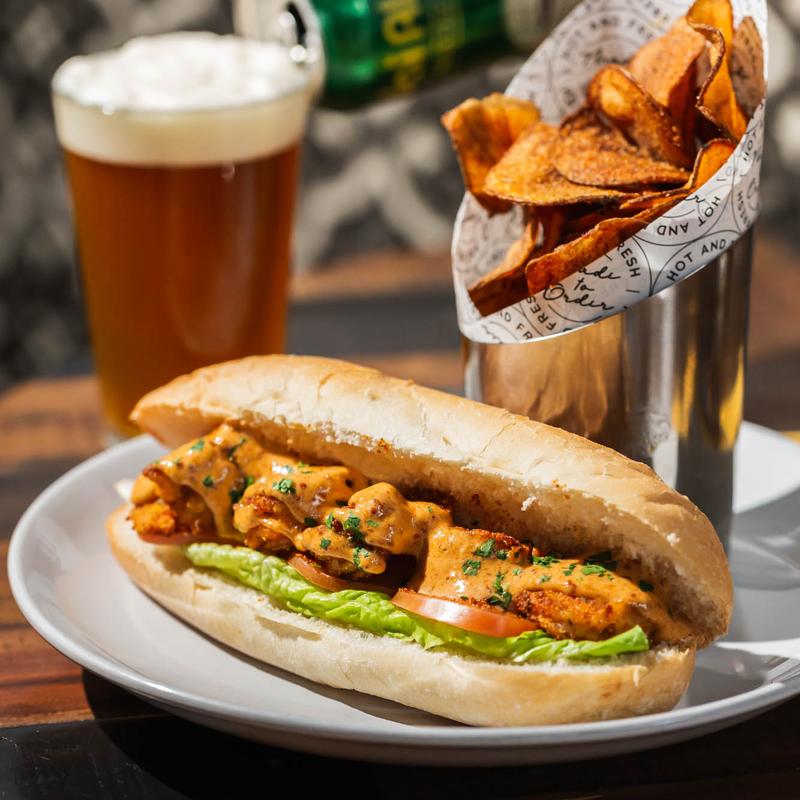
Crispy fried Gulf shrimp, dressed with crisp iceberg lettuce, fresh tomato, and our house-made rémoulade sauce — served on a full Leidenheimer loaf with house-fried potato chips on the side. This is the sandwich the Martin brothers were giving away to striking workers in 1929. We serve it the same way because there is no better way.
The Iconic Jazz Fest Crawfish Bread
Our single most-talked-about starter. Creamy cheese and sautéed crawfish tails tossed with the holy trinity — onion, celery, bell pepper — piled onto sliced Leidenheimer French bread and baked golden. This dish was inspired by the legendary crawfish bread sold at the New Orleans Jazz & Heritage Festival, a dish that has its own cult following. Getting the bread right is what makes it work. We got the bread right.
A Note on Sourcing
Sourcing Leidenheimer bread in New York City is not trivial. It’s not on the shelf at the local restaurant supply depot. It requires planning, relationship management, and a genuine commitment to doing things the right way rather than the convenient way.
We think that’s the right trade-off. Not because we’re precious about it — but because our guests deserve a po’boy that actually tastes like a po’boy, crawfish bread that could have come from a booth on the Festival Grounds in New Orleans, and a meal that connects them to something real.
That’s what Louisiana cuisine is about. It has always been about memory, heritage, and the specific flavors of a specific place, made with the specific ingredients that make those flavors possible.
We’re in Tribeca. But when you take a bite of that crawfish bread, you’re briefly, deliciously somewhere else.